
Time-Based Stop-Loss: Because Waiting Kills Accounts
Most traders believe that time has nothing to do with stop-loss. They think only price matters. But the harsh truth is this: the longer you stay in a losing trade, the worse the damage becomes. Time magnifies losses. Time destroys capital. Time increases emotional pressure. And when the clock runs long enough, even strong traders collapse mentally and exit at the worst possible level.
Time-based stop-loss is a rule that exits a trade automatically if the expected move does not happen within a predefined time window. The idea is simple—if the market is not moving in your direction fast enough, something is wrong. Strong trades move immediately. Weak trades drain time, capital, and psychology.
Why Time-Based Stop-Loss Is Critical for Survival
The market gives a clear sign very early. Good trades work fast. Bad trades drag and bleed slowly. Every second spent waiting for a reversal increases emotional stress and reduces rational decision-making. The trader stops analyzing and starts hoping.
- Prevents capital freezing in dead or slow-moving positions
- Protects from sideways chop and whipsaw traps
- Reduces emotional fatigue and revenge trading
- Keeps discipline intact during volatile conditions
- Improves capital rotation and trade frequency quality
If a trade cannot prove itself quickly, it does not deserve your capital.
Real Example: CRUDE OIL Intraday Trade
Trading Capital: ₹2,40,000
Entry: Sell Crude at 6,220
Trend expectation: Fast breakdown due to volume surge
| Approach | Exit | Outcome |
|---|---|---|
| No Time-Based SL (wait and hope) | Exit after 45 minutes | -30 points = ₹3,000 loss |
| Time-Based SL (10-minute rule) | Exit after 10 minutes | -5 points = ₹500 controlled loss |
Difference: ₹2,500 saved by exiting early instead of waiting for disaster.
Slow trades kill accounts gradually. Time-based stop-loss protects traders from psychological traps.
Time is more dangerous than price. Price hits your capital. Time hits your mind.
When Time-Based Stop-Loss Works Best
- Breakout and momentum strategies
- News and event-driven markets
- Highly volatile assets (BankNIFTY, Crude, Gold, Natural Gas)
- Scalping and short-timeframe trading
- High liquidity fast-moving markets like USDINR and EURUSD
Momentum either appears instantly or doesn’t belong to you.
Major Mistakes Traders Make Without Time-Based SL
- Holding losing trades too long “hoping” for reversal
- Freezing capital in dead trades
- Cutting winners early while letting losers run
- Waiting until pain becomes unbearable
Small delays create large damage. Large delays destroy accounts completely.
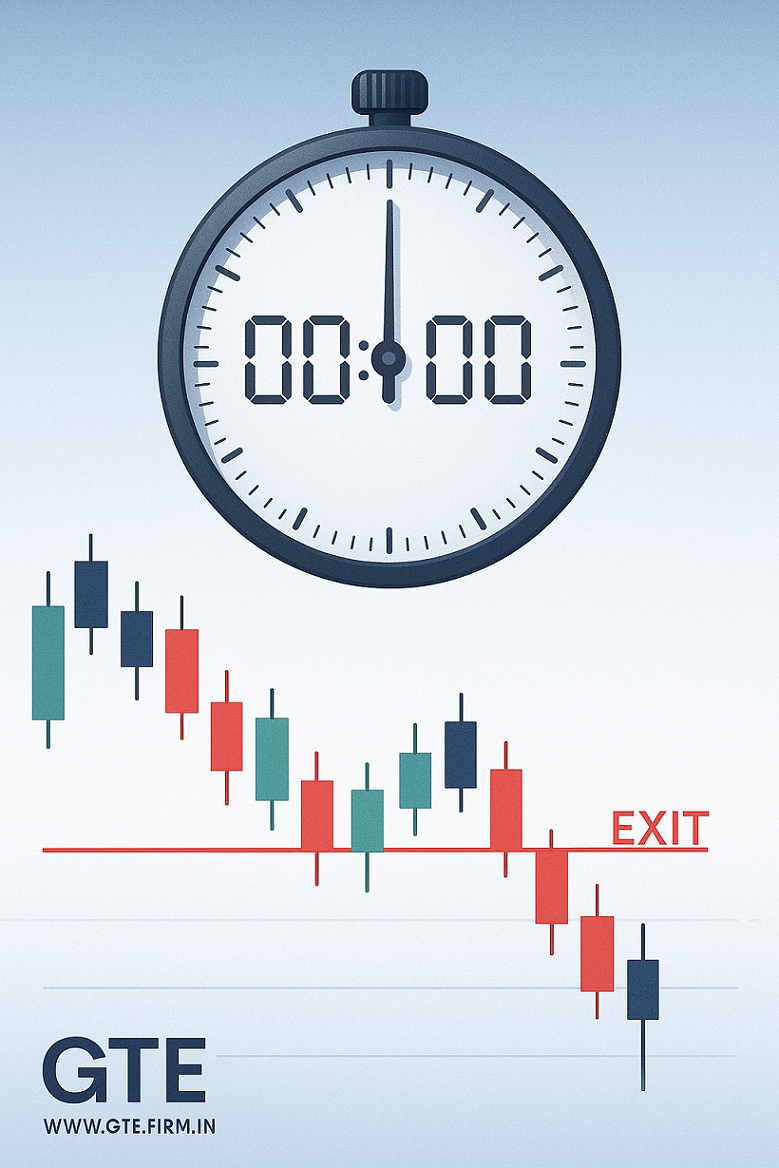
Inline Visual – Concept of Time Stop-Loss
The clock is as important as the chart. Time reveals weakness long before price does.
Why Automated Time Stop-Loss Is Superior
| Manual Time SL | Automated Time SL |
|---|---|
| Forgets time during emotional stress | Automatically triggers exit at defined limit |
| Hesitation and delay | Perfect execution |
| Late exits and big losses | Controlled small losses |
| No discipline enforcement | Permanent discipline |
Machines don’t wait. Humans wait until it’s too late.
Final Reality Check
If the move doesn’t start quickly, exit. Waiting does not fix bad trades. It destroys accounts.
Call or WhatsApp us today, or fill the contact form at https://www.gte.firm.in/wp/contact/ to automate time-based stop-loss execution and trade with discipline.
FAQs
How much time should I allow before exiting?
Depends on timeframe. 5–15 minutes for intraday momentum, 1–2 candles for swings.
Which assets benefit most?
BankNIFTY, Crude, Gold, Natural Gas, active FX pairs.
Can time-based SL be automated?
Yes. Automation prevents emotional waiting and protects capital.