
Stop-Loss & Risk–Reward Ratio: The Mathematical Truth Most Traders Ignore
The majority of retail traders lose money not because they lack profitable strategies, but because they completely ignore risk–reward ratio while placing stop-loss orders. They take large risks to chase small profits, and eventually the math destroys them. No trading system can survive a bad risk–reward structure.
Stop-loss and risk–reward ratio work together as the foundation of professional trading discipline. Stop-loss controls downside. Risk–reward ratio ensures upside is meaningful. Without both, trading becomes gambling.
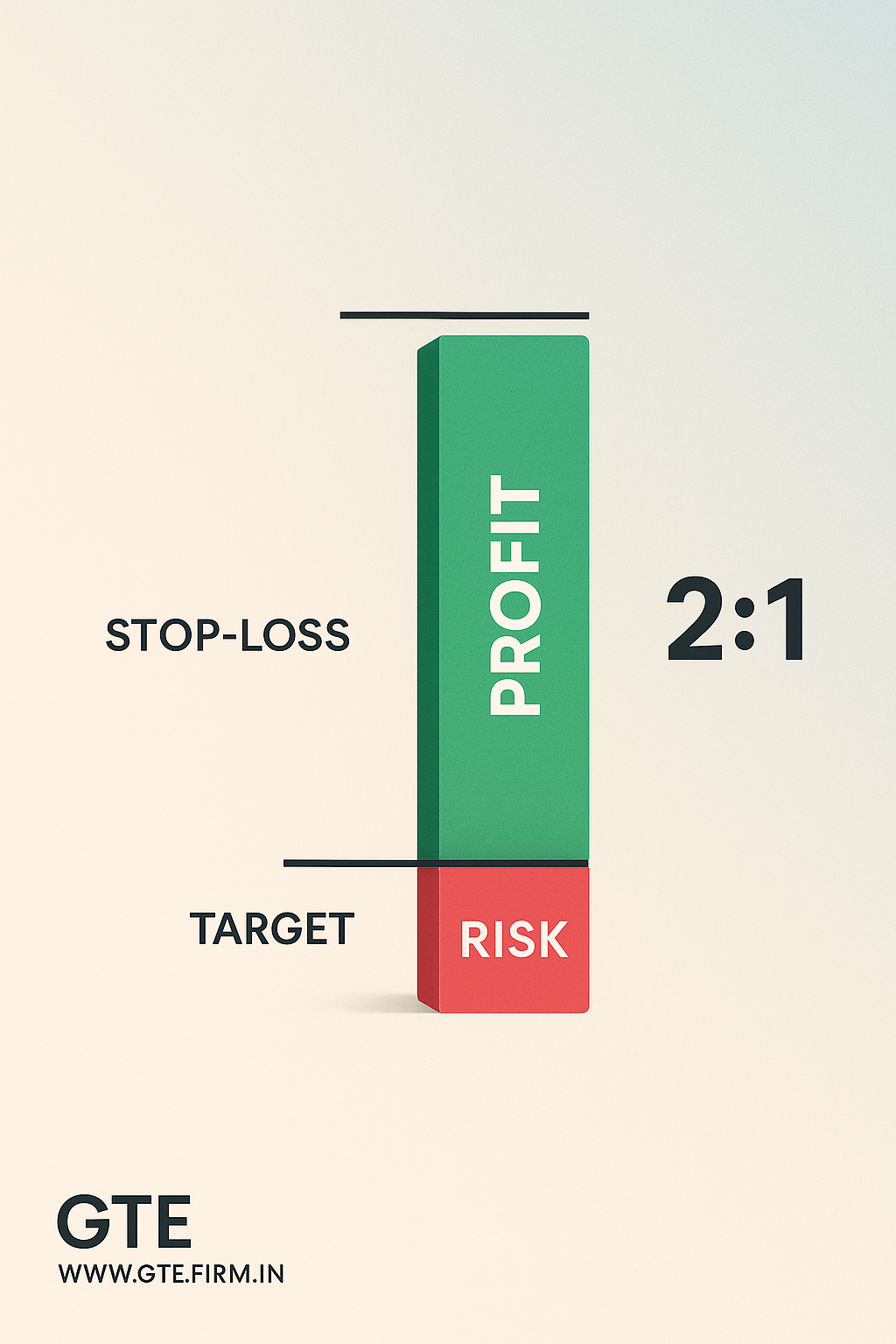
What Is Risk–Reward Ratio?
Risk–Reward Ratio (RRR) compares the amount you are willing to risk (stop-loss) to the amount you expect to gain (target). Example: A 1:3 risk–reward ratio means risking ₹1 to attempt earning ₹3.
| Risk–Reward Ratio | Risk | Target |
|---|---|---|
| 1:1 | ₹1,000 | ₹1,000 |
| 1:2 | ₹1,000 | ₹2,000 |
| 1:3 | ₹1,000 | ₹3,000 |
The better the ratio, the fewer winning trades you need to be profitable.
The Mathematical Truth Retail Traders Don’t Understand
You can be wrong more often than right and still make money — if your risk–reward ratio is correct.
| Risk–Reward Ratio | Win Rate Required to Break Even |
|---|---|
| 1:1 | 50% |
| 1:2 | 33% |
| 1:3 | 25% |
| 1:5 | 17% |
You don’t need 80% accuracy. You need smart risk control.
This is why traders blow up: they aim for ₹1,000 profit but risk ₹3,000 to get it. The math guarantees failure.
The market punishes bad math mercilessly. Risk–reward ratio is survival mathematics.
Example: NIFTY Futures Risk–Reward Reality
Trade Setup:
Entry: Long NIFTY at 21,450
Stop-Loss: 21,400 (50-point risk = approx ₹2,500)
Target: 21,600 (150 points = approx ₹7,500)
| Scenario | Outcome | Net Result |
|---|---|---|
| Hit SL | Loss | -₹2,500 |
| Hit Target | Gain | ₹7,500 |
Even winning 1 out of 3 trades is profitable:
Two loses = -₹5,000
One win = +₹7,500
Net = +₹2,500
But most retail traders reverse this — they target small profits and accept huge risk.
Inline Concept Visual — Risk–Reward Ratio Explained
Before every trade, the first question must be:
“Is the reward big enough to justify the risk?”
If the answer is no — walk away.
Where Risk–Reward & Stop-Loss Strategy Works Best
- Breakout and trend continuation trades
- Pullback entries near structure or moving averages
- Volatile markets like BankNIFTY and commodities
- Event-driven momentum setups
- High RRR swing trades
Trading is not about winning every trade. It is about losing small and winning big.
Why Automation Makes Risk–Reward Execution Better
| Manual Trading | Automated Trading |
|---|---|
| Inconsistent SL/Target placement | Standardized structure-based levels |
| Fear kills winners too early | Rules protect large targets |
| Hope holds losing trades longer | Forced small loss discipline |
| Emotion overrides logic | Zero emotion |
Consistency is impossible without automation. Discipline fails under stress.
Final Punch
Even a 20% accuracy trader can make money with the right risk–reward strategy. But a 90% accuracy trader will still go bankrupt with a bad one.
Call or WhatsApp us today, or fill the contact form at https://www.gte.firm.in/wp/contact/ to automate stop-loss and risk–reward execution for professional trading consistency.
FAQs
What is the best risk–reward ratio?
1:2 or 1:3 minimum for intraday, higher for swing and positional.
Can risk–reward be automated?
Yes. Targets and stop-loss levels can be dynamically executed based on defined ratio logic.
Why do most traders fail?
They risk big to win small and emotionally reverse exits.