
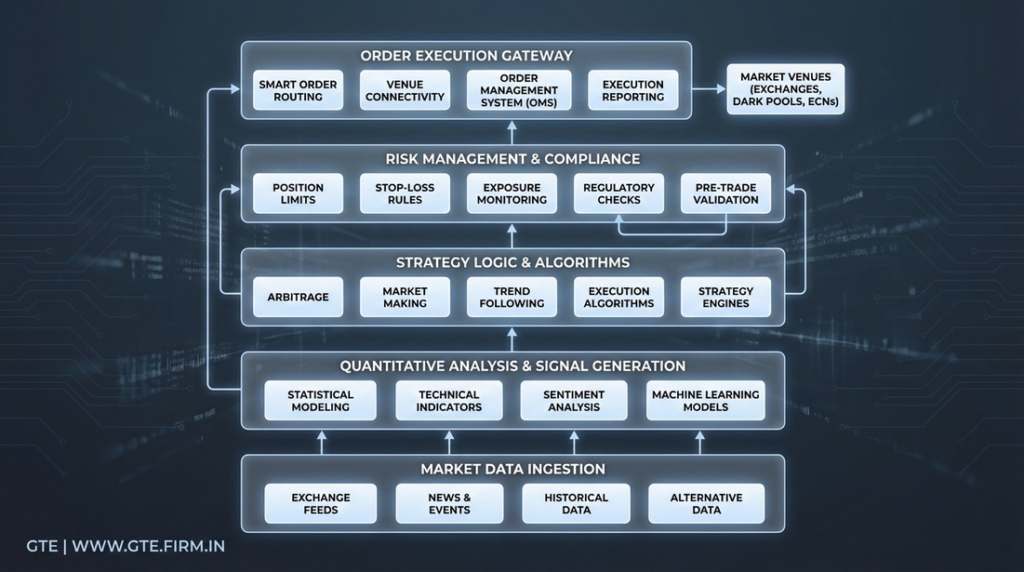
Algorithmic Trading: A Systematic Approach to Market Participation
Algorithmic trading refers to the use of rule-based systems to analyse market data, generate decisions, and execute trades with minimal manual intervention.
Despite its popularity, algorithmic trading is often misunderstood. It is not a shortcut to profits, nor does it eliminate risk. At its core, it is a method of applying structure, discipline, and repeatability to trading decisions.
What Algorithmic Trading Actually Means
In practical terms, algorithmic trading involves defining a set of rules that describe:
- What market conditions are being observed
- When an action should be taken
- How that action should be executed
- What constraints and limits apply
These rules can be based on price behaviour, volume, volatility, statistical relationships, or other measurable factors. The system then applies those rules consistently, without emotion or discretion.
Common Misconceptions About Algorithmic Trading
- “Algorithms guarantee profits” – They do not. They only enforce logic consistently.
- “Algo trading removes risk” – Risk still exists; it is simply managed more explicitly.
- “Algorithms replace thinking” – Poor assumptions lead to poor algorithms.
- “Only institutions can do algo trading” – The tools are accessible, but discipline is required.
Understanding these limitations is critical before attempting to automate any trading activity.
The Core Components of an Algorithmic Trading System

Most algorithmic trading systems are built as a collection of distinct components, each with a specific responsibility.
1. Market Analysis
This layer focuses on understanding market conditions. It may involve indicators, statistical studies, correlations, or pattern recognition. Analysis does not make decisions — it provides context.
2. Signal Generation
Signals are structured outcomes derived from analysis. They define *when* a condition of interest has occurred, but not necessarily how it should be traded.
3. Strategy Logic
Strategy logic combines signals with rules for entries, exits, position sizing, and timing. This is where assumptions are formalised and tested.
4. Risk Management
Risk controls define exposure limits, stop conditions, capital allocation, and fail-safes. This layer exists to ensure that no single idea can cause disproportionate damage.
5. Execution
The execution layer handles order placement, broker interaction, error handling, and confirmations. Execution quality has a direct impact on real-world outcomes.
Why Separation of Components Matters
One of the most common mistakes in algorithmic trading is combining all logic into a single, opaque system.
Separating analysis, decision-making, and execution provides:
- Greater transparency
- Easier debugging and testing
- Improved scalability
- Better risk containment
It also allows individual components to evolve independently as market conditions or requirements change.
Backtesting and Its Limitations
Backtesting is the process of applying trading rules to historical data to observe how they would have behaved.
While backtesting is essential, it has limitations:
- Historical data does not capture future market structure
- Execution constraints are often simplified
- Over-optimisation can distort results
Backtests should be treated as behavioural studies, not performance guarantees.
From Semi-Automation to Full Automation
Not all algorithmic trading systems are fully automated.
- Semi-automated systems assist with analysis and alerts
- Execution-assisted systems automate order placement with oversight
- Fully automated systems operate end-to-end under predefined constraints
The appropriate level of automation depends on objectives, infrastructure, and risk tolerance.
Algorithmic Trading as Infrastructure, Not a Shortcut
Well-designed algorithmic trading systems resemble infrastructure more than strategies. They are frameworks that enforce discipline, document assumptions, and make behaviour observable.
When approached correctly, algorithmic trading is less about prediction and more about process control.
Where to Go Next
Algorithmic trading is best understood as a progression:
- Understanding markets and data
- Formalising rules and assumptions
- Testing behaviour under different conditions
- Applying automation where it adds value
Different participants engage at different stages of this progression.
Structure first. Automation second. Outcomes last.